
21 Sep Three daily movements to avoid injury, aches and pains
September 21st, 2020
As a trainer with well-known clients, a team, and an attractive location in central London I was frequently approached by journalists looking for fodder for their articles. Typically, tips, tricks and an expert’s view on the latest ‘thing’ was being sought. A memorable request was for ‘Confessions of a Personal Trainer’ (looking for dirt, no doubt; I declined). One of my favourite requests was ‘What do people really want?’.
You might imagine that the answer is ‘lose weight’. Sure, that’s what 90% of people walked in the door for, but when you scratched the surface just a little, we found that most people really wanted something else entirely once that initial request had been addressed. Some of the things which came up later in that initial consultation (or after a few sessions) included ‘getting control of eating habits’, ‘having enough energy to keep up with the kids’, ‘having a set period of time in the week for “Me”’. The one I want to address today is ‘getting pain free’.
I used to wonder why this would come up so often… surely people in ‘pain’ would seek out advice and treatment from a doctor or physiotherapist? Not always. Many people want to carry on doing what they’ve always done, for as long as they can – like running well while reducing injury risk. Of course we all have different pain tolerances, but everyone has a pain threshold at which they will seek out medical help. Below this however is that zone where people ‘get by’ with that back niggle, stiff shoulder or sore knee. Also, as we age we become more aware of the maladies that affect our parents and/or older friends and relatives, and wonder not only what we can do to avoid similar outcomes, but what tips we can learn to help both us and them..
Over time, an area of tightness can easily lead to a chronic ache… which all too often develops into an injury. ‘Typical’ areas of weakness and imbalance can lead to avoidable discomfort in our later years. Developing a little ‘full-body’ strength drastically reduces our chances of falls in our dotage… and minimises the consequences if we do.
With all of that in mind here are three of the key movements which we found reaped huge benefits for most of our new starters. Performed daily, these go a long way to increasing mobility in key areas and thus reducing a range of aches and pains. Longer term benefits include the laying of foundations upon which we can build the robustness to protect you from future avoidable discomfort. Perform each movement for 2 minutes, or as part of your recovery between training sessions.
Squat-to-Stand
– Stand tall, with a wide stance before squatting down low and grasping your toes (or ankles/shins, as flexibility allows). Keep your chest high and your eyes forward.
– Push the hips high, straightening the legs until you feel a stretch in the hamstrings. Look down, and keep a firm grasp of the toes/ankles/shins.
– Keeping a hold of the toes, lower the hips and return to the starting position.
– Click here: https://bit.ly/3iaq8oM
Half-Kneeling Hip Flexor Mobilisation (Rising Arm)
– Start on a mat (so that you have some cushioning for your rear knee). Place your left foot flat and grasp the knee, while your right knee is down. Ensure both knees are at 90 degrees and your torso is vertical.
– Rock your torso forward, raising your right arm as you go. Aim to push your left knee forward by a few inches, and get your arm up to your ear. Pause when you feel a stretch across the right hip, before returning to the starting position.
– Click here: https://bit.ly/2Zc665T
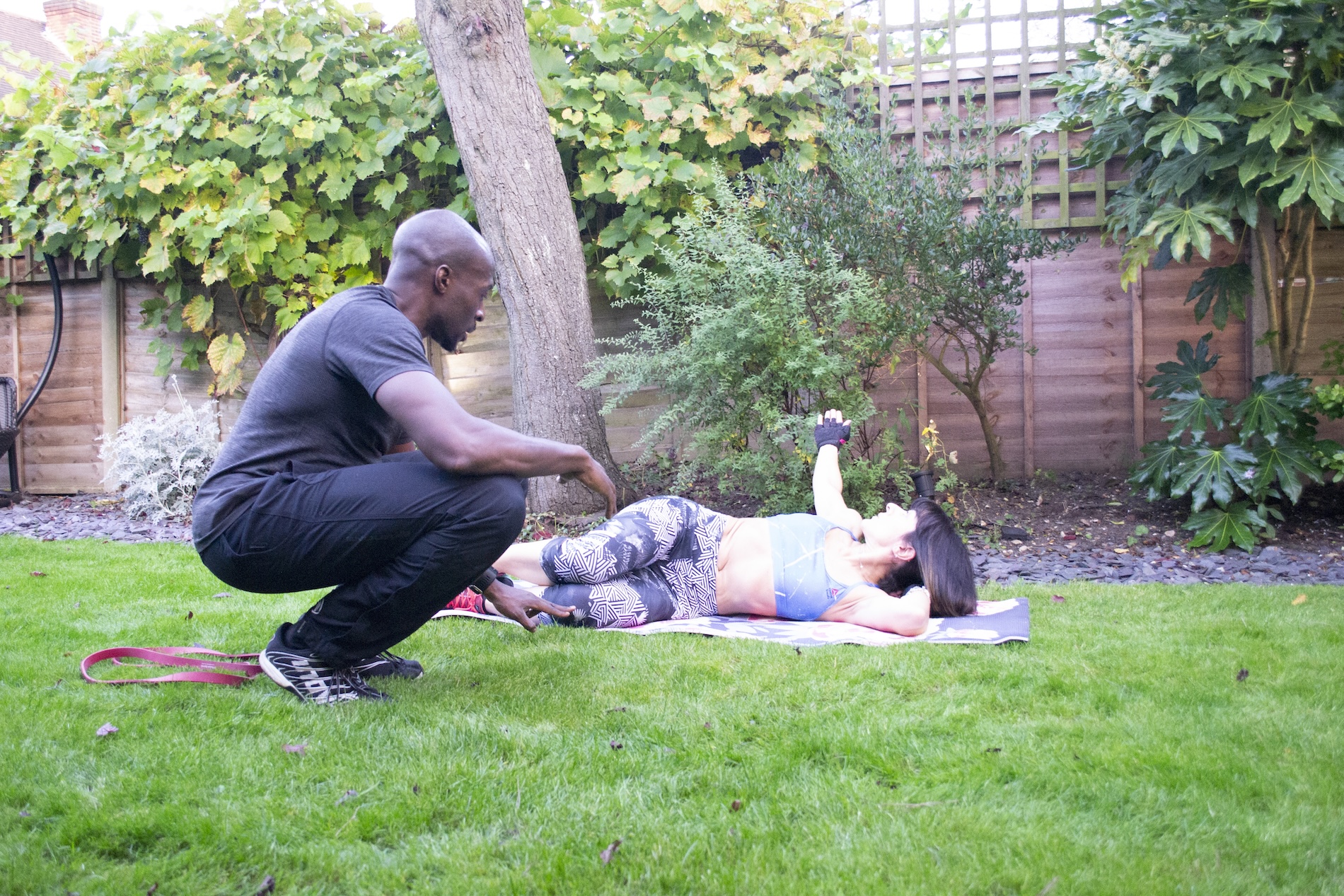
Side-Lying Windmill
– Lie on your side with your head supported. Bend the knees, and align the feet, knees and hips on top of one another. The arms should be straight out in front of you, palms facing each other.
– Aiming to form as large an arc as possible, move the top hand above the head, reaching out behind your head. Aim to keep the knees together, and the lower and in position and still.
– Click here: https://bit.ly/338bwjk
For those who are able. 1-to-1 personal training in Soho, London remains available – alongside the ‘access-anywhere’ Lean Dad Project.
Ayo Williams